reflective student
Reflection can be a challenging endeavor. It’s not something that’s fostered in school – typically someone else tells you how you’re doing! At best, students can narrate what they did, but have trouble thinking abstractly about their learning – patterns, connections and progress.
In an effort to help schools become more reflective learning environments, I’ve developed this “Taxonomy of Reflection” – modeled on Bloom’s approach. It’s posted in four installments:
1. A Taxonomy of Reflection
2. The Reflective Student
3. The Reflective Teacher
4. The Reflective Principal
See my Prezi tour of the Taxonomy
2. The Reflective Student
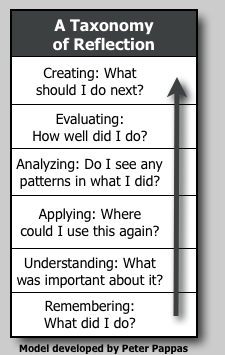
Each level of reflection is structured to parallel Bloom’s taxonomy. (See installment 1 for more on the model). Assume that a student looked back on a project or assignment they had completed. What sample questions might they ask themselves as they move from lower to higher order reflection? (Note: I’m not suggesting that all questions are asked after every project – feel free to pick a few that work for you.) Remember that each level can be used to support mastery of the new Common Core standards.
taxonomy of reflection
Bloom’s Remembering: What did I do?
Student Reflection: What was the assignment? When was it due? Did I get it turned in on time?
Bloom’s Understanding: What was important about what I did? Did I meet my goals?
Student Reflection: Do I understand the parts of the assignment and how they connect? Did my response completely cover all parts of the assignment? Do I see where this fits in with what we are studying?
Bloom’s Application: When did I do this before? Where could I use this again?
Student Reflection: How was this assignment similar to other assignments? (in this course or others). Do I see connections in either content, product or process? Are there ways to adapt it to other assignments? Where could I use this (content, product or process) my life?
Bloom’s Analysis: Do I see any patterns or relationships in what I did?
Student Reflection: Were the strategies, skills and procedures I used effective for this assignment? Do I see any patterns in how I approached my work – such as following an outline, keeping to deadlines? What were the results of the approach I used – was it efficient, or could I have eliminated or reorganized steps?
Bloom’s Evaluation: How well did I do? What worked? What do I need to improve?
Student Reflection: What are we learning and is it important? Did I do an effective job of communicating my learning to others? What have I learned about my strengths and my areas in need of improvement? How am I progressing as a learner?
Bloom’s Creation: What should I do next? What’s my plan / design?
Student Reflection: How can I best use my strengths to improve? What steps should I take or resources should I use to meet my challenges? What suggestions do I have for my teacher or my peers to improve our learning environment? How can I adapt this content or skill to make a difference in my life?
Image credit: flickr/Daveybot

After working on a collaborative project, I had my class fill out a reflection sheet, based on Peter’s ideas. When they had finished writing about it, I asked their response to doing the reflection. “I love writing a reflection. It finishes out the activity. It’s like a period at the end.”
Just what I was after!
Hi Peter,
Thank you for the comment on my blog. You requested the link and here it is.
http://ateacherswonderings.posterous.com/reflection-with-and-by-students
Christina, Thanks for adding the link to you post “Reflection with and by Students” It’s an excellent collection of reflective prompts for elementary students – worth looking at!
Hi Peter,
Thanks for the link to your blog. I find student reflection such a fascinating area of learning and one that I constantly strive toward supporting in each child. Like you I also have attempted to map out the journey of reflective learning, here is my “work in progress.” Any comments most welcome:
http://www.scribd.com/doc/38236032/A-Developmental-Model-of-Relfection
Gareth,
I looked at your reflective map in link above. Another great approach to reflection. I recommend it to my readers!
Thanks for posting! ~ Peter
I would like to thank the author for this marvelous efforts .I appreciate your efforts in preparing this post. I really like your blog articles.
I would like to thank Peter for this wonderful effort, it’s worth referring. Much appreciate & thanks once again for sharing!
What is the best way to teach concrete thinking 2nd graders?
Hi Victoria, An interesting question, but I’m afraid that I’m not equipped to give you a good answer. Perhaps one of my readers can be of help. Sorry~ Peter
Mr Peter Pappas,
Your work is excellent and I am grateful to have found this website. tqtqtqvm
Hey Peter –
I really enjoyed this post – it was a great anchor for reflection for my middle school writers. Their reflections were much more meaningful and purposeful as a result. Thank you for sharing.
Tia,
So glad to hear that you found some inspiration in my post. I took a look at your blog and thought I’d provide a link so my readers cans see some of your reflections.
Cheers ~ Peter
I feel like I found a box of treasure. Not being in the educational industry directly, I had not heard of this methodology. Thank you Peter for this.
Daniel,
Thanks for taking the time to comment and share your thoughts. Glad to offer it up for all to enjoy.
~ Cheers, Peter
This is a marvelous post! As an NBCT, I highly value reflection for it’s positive benefit on my teaching practice. I am very excited to use this approach with my intermediate grade gifted students this year! It hits several of our standards, and I’m sure it will have a positive benefit for their learning. Thank you for sharing this good work!
Karen,
Glad you see value in the model. I appreciate the feedback.
~ Cheers, Peter
Hi. I’m Ikke from Indonesia. Can I ask you about Taxonomy of reflection. What should taxonomy of reflection sequence? Can I use it for students to solve problems by Polya theory? whether it should be after the students solve the problem? thank you.
Hi Ikke,
I think the Taxonomy is best used to reflect after a learning experience. Once students get proficient at reflection, then you can also use before a lesson for students to consider how they will approach the task. Sorry, I’m not familiar with the Polya theory.
Cheers,
Peter
Sir, can I ask one more again? What before entering a high level in the taxonomy of reflection must meet the lowest level first ? Thank you ^_^
I think it makes sense to start at the lower end of the taxonomy. Once students become more reflective, they could move more directly to the higher end.
Thanks for your info Sir, I ‘m doing research on student reflection using the taxonomy of reflection in order to end the task . wish it was a success.
Ikke,
If you are starting at lower levels you are asking the students “what was the task?” The reflective elements of blooms taxonomy are Application, Analysis, Synthesis, and Evaluation.
I don’t think the author is saying to get rid of these elements, just that he wants these higher levels of thinking (reflective elements) to be addressed in the classroom.
I’ve made the error in my own class to try and jump straight to creating, or evaluation. The student was unable to answer this sort of question because they had not reflected enough on the process. These steps are great scaffold for the student to reach those higher levels of thinking. It’s sad to see classes where the teacher can only interact with the students on the first two levels because it is all they know.
Well stated, Joey.
I love this site during my free time I go on here I even shared this site with my friends.I even told the teachers at the computer lab and they turned this into a learning subject I <3 peter pappas thank you so much
Dear peter thanks for making this site I come here on my free time I 100% understand and rember everything from my computer class to show my support I will share this site with all my friends and teachers I Thank you very much