Peter Pappas »
19 February 2013 »
In Ed Tech, How To, PD, Social Web, Teachers, Web 2.0 »

I critiqued the "top-down vision of innovation in schools" in a post Innovations in Teaching and Learning: Top Down or Bottom Up?
Want to find out more about instructional innovation in action? That won't cost you a thing either. Just jump on my Twitter feed and you find superb teachers willing to share their latest student projects. And that free flow of information contrasts with a second "top-down" approach to innovation in schools - the professional learning committee. Imagine being told that, "teachers will now attend PLC meetings.. and don't forget to fill out the PLC report form and turn it in to your administrator." No one at the top seems to notice that teachers who want to network have already created their own "bottom-up" support systems via the social web.
PLCs for singleton teachers?
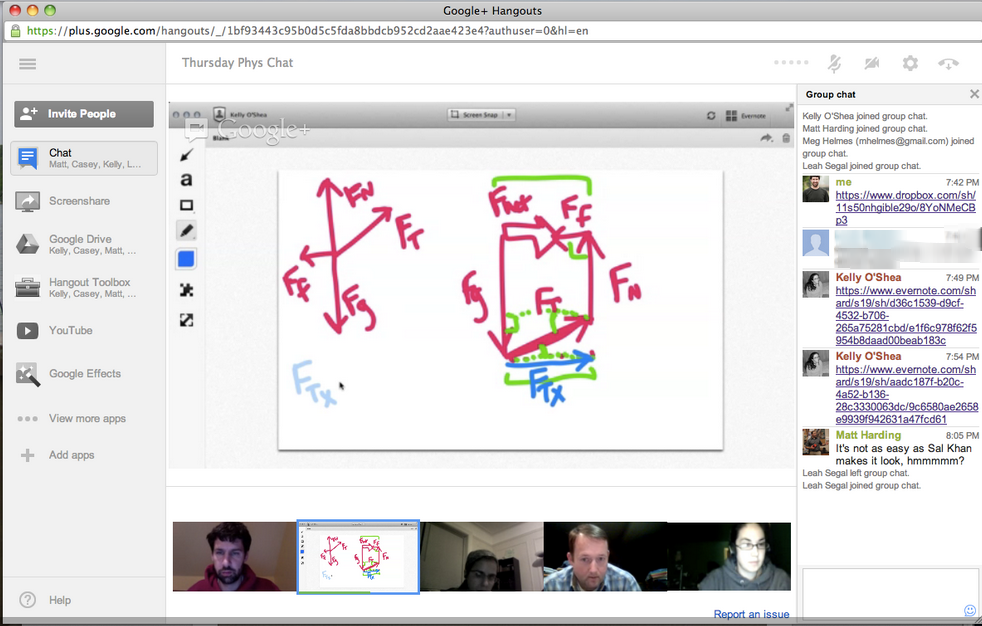
A recent post by high school physics teacher Casey Rutherford, describes how he used Google+ Hangouts (free video conferencing) to create his own PLC. A Physics PLC: Collaboration at a Distance. Casey writes:
This year my school district, like many others, implemented PLCs (Professional Learning Communities) as the driving force behind how we collaborate to help students learn. The directive was that all teachers should meet in a PLC weekly for approximately 30 minutes. This sounds, and can be, great, but I had a problem. …. For 7 years I had been the only physics teacher. ...
Enter Twitter. I’ve been on Twitter almost two years now, and I have learned more on Twitter in these two years than the previous six, which included a masters degree. Among other things I have managed to build a pretty awesome PLN (Personal Learning Network) that includes a couple hundred incredible physics and math teachers from around the country.
Casey posted a tweet with a link to Google doc soliciting members for his online PLC:
My name is Casey Rutherford. I am entering teaching for the 8th year, my 7th teaching physics, and my first using Modeling Instruction. I have a relatively odd request.
My school is implementing PLCs, certainly a worthy task. The problem is that at this point there is not a logical person with whom I would form a PLC. Thus my request. I am wondering if any of you would like to form an online PLC with me, working together approximately 30 minutes/week to compare student work. My thought is that we can do a lot with formative assessments, using photos of student whiteboards to form the basis for our conversations. I am, however, open to other ideas as well. ...
What follows is Casey's step-by-step description of how his team used a G+ Hangout to manage their PLC sessions. It includes details about managing the Hangout, using it to analyze student work, and building meaningful collegial relationships. It's a very helpful post for anyone looking for practical information on using G+ Hangouts.

Hat tip to Marshall Memo for leading me to Casey's piece.
Screenshot credit / Casey Rutherford
Tags: Google, PLC, Science, STEM, Twitter
Peter Pappas »
16 August 2012 »
In Ed Tech, How To, Literacy, Projects, Publishing, Reflection, Strategies, Students »
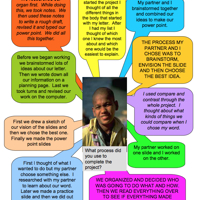
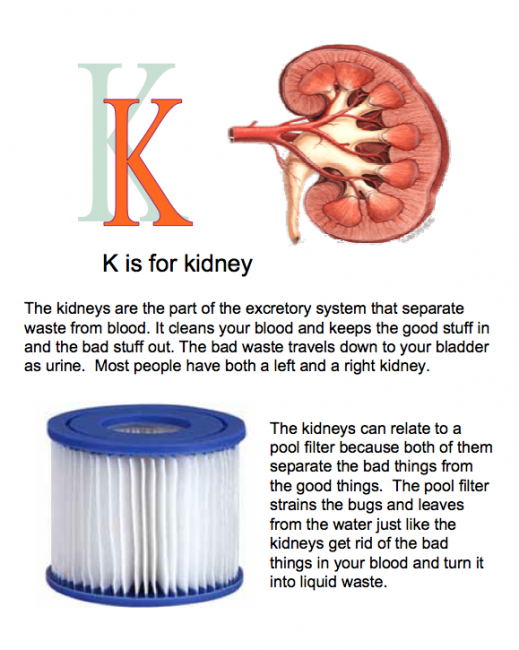
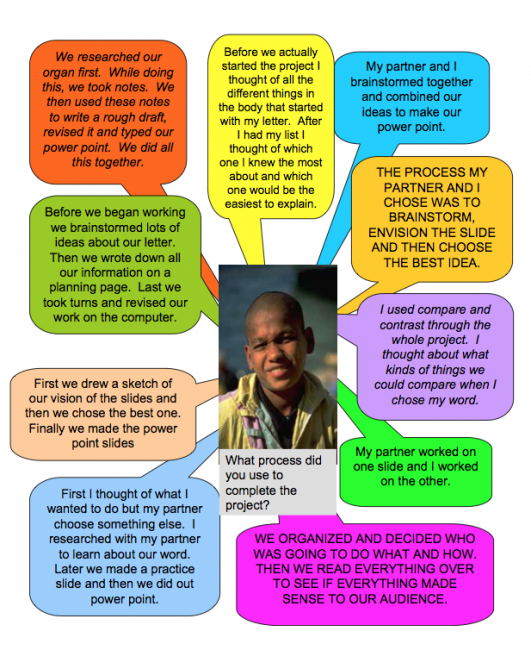
A step-by-step guide to student writing that demonstrates the power of student choice, authentic audience and self-reflection. Sixth graders are motivated by writing “Traveling Through the Human Body with ABCs” for a third grade audience. The project demonstrates how to help students master content and develop project management and teamwork skills. The power of publishing enables students to think like writers, to apply their learning strategies and to organize and express their learning. It exemplifies the best of the information revolution – students as creators of content rather than as passive audience.
Tags: Comparing, Creativity, Critical thinking, Defining, ebook, Engagement, Higher-order thinking, iBook, iBooks Author, Lulu, Marzano, Motivation, PBL, Science, STEM, Writing
Peter Pappas »
12 January 2012 »
In Commentary, Visualizations »
It’s unfortunate that student don’t get to use their innate perceptual skills more often in the classroom. Instead of discovering patterns on their own, students are “taught” to memorize patterns developed by someone else. Rather than do the messy work of having to figure out what’s going on, students are saddled with graphic organizers which take all the thinking out of the exercise. This clever video, “Doodling in Math Class: Spirals, Fibonacci, and Being a Plant” captures the fascination of patterns in nature.
Tags: Amusements, Artist, Comparing, Creativity, Design, Math, Science, Vi Hart
Peter Pappas »
29 November 2011 »
In Ed Tech, Events, Guest post, How To, Students »
Is our goal to have students performing better on standardized tests or to be prepared for what they are going to encounter in college and life? The ideal would be that they would be prepared for both. So the questions become, what do we want to leave the students with? How are we going to prepare them for the real world? What do we want them to learn about themselves? And how do we do it? To clear the air, I don’t believe that students are taking my calculus class because they need help doubling a recipe or balancing their checkbook. I believe it is because we want to expose students to the poetry of numbers, to have a new outlook on how to solve problems, to be able to think outside of the box, and to see how the unbreakable human spirit has conquered problems that once mystified the greatest of thinkers. Like any great symphony, mathematics represents a pinnacle of human creativity. We teach math to enrich the lives of our students in a way akin to reading poetry or composing music. This is the story of a student-created exhibit showcasing the beauty, humanity and intrigue behind math in history, philosophy and the applied arts.
Tags: Artist, Close reading, Creativity, Critical thinking, David Stahnke, Engagement, Essential questions, High Tech High, Higher-order thinking, IEF, Innovation, Margaret Noble, Math, Microsoft, Motivation, Music, PBL, Relevance, Rigor, Science, STEM
Peter Pappas »
12 June 2011 »
In Strategies, Students »
Students explore their world with an expectation of choice and control that redefines traditional notions of learning and literacy. Educators are discovering that they can motivate students with a PBL approach that engages their students with the opportunity to behave like STEM professionals while solving real-world problems. I’m in the Wisconsin Dells to deliver a four-hour training session for CESA 6. It’s entitled “21st Century Skills in Action: Project Based Learning in the STEM Classroom.” We’ll be using a Turning Point ARS and lots of activities so that participants experience the why, what, and how of PBL in the STEM curriculum.
Tags: Apps, Curriculum, Defining, Engagement, Motivation, Music, PBL, Relevance, Science, STEM
Peter Pappas »
07 June 2011 »
In Commentary, Strategies, Students »
It’s unfortunate that student don’t get to use their innate perceptual skills more often in the classroom. Instead of discovering patterns on their own, student are “taught” to memorize patterns developed by someone else. Rather than do the messy work of having to figure out what’s going on and how to group what they see – students are saddled with graphic organizers which take all the thinking out of the exercise. Filling out a Venn diagram isn’t analysis – it’s information filing. Instead of being given a variety of math problems to solve that require different problem-solving strategies, students are taught a specific process then given ten versions of the same problem to solve for homework. No pattern recognition required here – all they have to do is simply keep applying the same procedures to new data sets. Isn’t that what spreadsheets are for?
Tags: Algebra, Common Core, Curriculum, Data, Evaluation, Motivation, Organizers, Relevance, Rigor, Science
Peter Pappas »
06 February 2011 »
In Leadership, Strategies, Teachers »
“Look 4s for School Leaders.” It’s a succinct guide for principals, instructional leaders and can be used as reflective prompts by teachers. Put these in your toolkit and don’t forget they are all critical aspects to Common Core mastery.
Tags: Close reading, Common Core, Defining, Science, Twitter, Walkthrough
Peter Pappas »
20 January 2011 »
In Strategies »
Taking a test is not just a passive mechanism for assessing how much people know, according to new research. It actually helps people learn, and it works better than a number of other studying techniques.
Tags: NYT, Organizers, Science
Peter Pappas »
08 December 2010 »
In Commentary, Ed Policy, Literacy, Strategies, Students »
The latest results from the Program for International Student Assessment (PISA) are public, and already some pundits are declaring it “a Sputnik wake-up.” Others shout back that international comparisons aren’t valid. Rather than wade into that debate, I’d rather look more closely at the questions in the PISA test and what student responses tell us about American education. You can put international comparisons aside for that analysis. Are American students able to analyze, reason and communicate their ideas effectively? Do they have the capacity to continue learning throughout life? Have schools been forced to sacrifice creative problem solving for “adequate yearly progress” on state tests? PISA provides some answers to those questions and offers an insight into the type of problem solving that rarely turns up American state testing. Here’s a sample PISA question that gives some insights into what American students can (and cannot) do.
Tags: Close reading, Common Core, Curriculum, Data, Engagement, Higher-order thinking, Motivation, PBL, PISA, Rigor, Science, Sequencing, Sputnik, Test prep
Peter Pappas »
06 December 2010 »
In Ed Policy, Strategies »
Let’s see how the Duncan sidesteps the issue of testing and innovation – while US students spend endless hours honing their test taking skills, the demand for routine skills has disappeared from the workplace. Anyone know of a meaningful and rewarding career that looks like filling out a worksheet? Maybe Friedman will be willing to tackle the stifling impact of testing on creativity thinking among our students.
Tags: Creativity, Critical thinking, Curriculum, Duncan, Essential questions, Google, Higher-order thinking, Innovation, Math, NYT, Routine skills, Science, STEM, Test prep, Twitter
Recent Comments