Peter Pappas »
06 September 2012 »
In Commentary, Leadership, Visualizations »
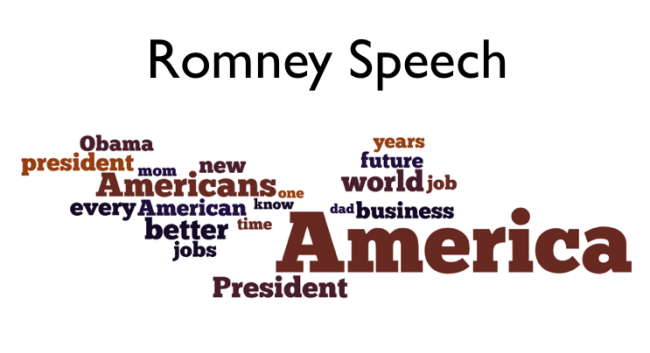
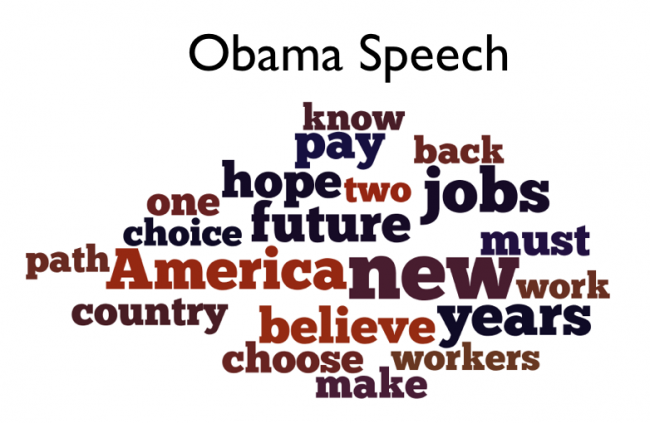
Here’s a Wordle comparison of the top twenty words used in the each candidate’s speech to their conventions. Font size represents frequency that the word appeared in their speech as prepared for delivery. Seems to be “America” vs “new.”


Sources:
Romney’s Speech to the Republican Convention NY Times
President Obama’s Prepared Remarks From the Democratic National Convention NY Times
Tags: Civic literacy, Civics, Infographic, NYT, Obama, Romney, Wordle
Peter Pappas »
15 August 2012 »
In Commentary, Literacy »
What is writing for? The answers seem obvious — communication, persuasion, expression. But the real answer in most classrooms is this: writing is for making assigned writing. Throughout their education, students everywhere are asked repeatedly to write papers that are inherently insincere exercises in rearranging things they’ve read or been told — papers in which their only stake is a grade.
Tags: Creativity, Engagement, Evaluation, Klinkenborg, Motivation, NYT, Writing
Peter Pappas »
09 January 2012 »
In Commentary »
Let’s stop acting like hollowed-out zombies, with BlackBerrys and iPhones replacing eye contact, handshakes and face-to-face conversations. It’s time to live once again in the present and simply be where we are.
Tags: Amusements, Casey Neistat, Information landscape, iPhone, NYT, Smartphone, Texting
Peter Pappas »
13 April 2011 »
In Commentary »
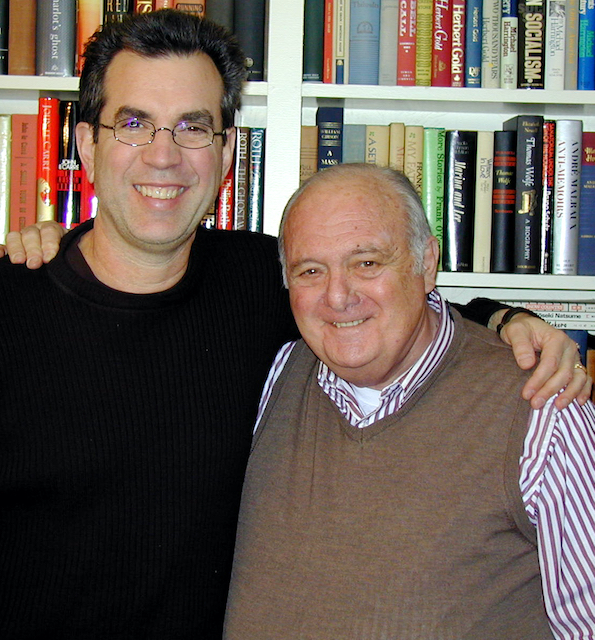
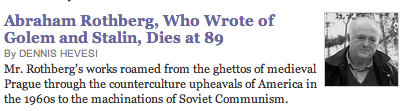
Two weeks ago, I lost a very important person in my life. For more than 25 years Abe Rothberg served as friend, mentor, surrogate father and personal curmudgeon. Over long lunches in diners or late afternoons in his study we’d discuss politics, history, literature, journalism and gossip about everyone we knew.
Tags: Friends, NYT, Rothberg, Writing
Peter Pappas »
20 January 2011 »
In Strategies »
Taking a test is not just a passive mechanism for assessing how much people know, according to new research. It actually helps people learn, and it works better than a number of other studying techniques.
Tags: NYT, Organizers, Science
Peter Pappas »
06 December 2010 »
In Ed Policy, Strategies »
Let’s see how the Duncan sidesteps the issue of testing and innovation – while US students spend endless hours honing their test taking skills, the demand for routine skills has disappeared from the workplace. Anyone know of a meaningful and rewarding career that looks like filling out a worksheet? Maybe Friedman will be willing to tackle the stifling impact of testing on creativity thinking among our students.
Tags: Creativity, Critical thinking, Curriculum, Duncan, Essential questions, Google, Higher-order thinking, Innovation, Math, NYT, Routine skills, Science, STEM, Test prep, Twitter
Peter Pappas »
22 November 2010 »
In Commentary, Ed Tech, Literacy »
The cost of information is rapidly approaching zero. Normally as price of a commodity drops, we consume more of it. But unlike all the other cheap stuff we buy, and then later discard, cheap information demands our attention. Despite all the claims of multi-tasking, we are stuck with a finite attention span. Thus the ability to selectively filter out unwanted information and stay focussed on a task is emerging as a new literacy.
Tags: Common Core, Critical thinking, Defining, Evaluation, Filtering, Focus, NYT
Peter Pappas »
17 October 2010 »
In Commentary, Ed Policy »
Unless we institute more genuine assessments, our measures of student achievement will be as inspiring as a steroid-tarnished home run record.
Tags: Creativity, Decision making, Defining, Engagement, Music, NYT, Routine skills, Test prep
Peter Pappas »
28 September 2010 »
In Commentary, Ed Policy, Leadership, Teachers »
A decade ago, Brockton High School was a case study in failure. Teachers and administrators often voiced the unofficial school motto in hallway chitchat: students have a right to fail if they want. And many of them did — only a quarter of the students passed statewide exams. One in three dropped out. Then Susan Szachowicz and a handful of fellow teachers decided to take action.
Tags: Duncan, NYT, Parents, Reform, Unions, Writing
Peter Pappas »
05 March 2009 »
In Commentary, Ed Tech, Web 2.0 »
Museums share at least one thing in common with schools. They have traditionally functioned as repositories of information.
Visit a museum and you can view the information (art) that a curator has selected, organized, and presented. Often its significance and meaning will be explained to you in a wall label. In the traditional school, curriculum experts select information that teachers organize and present to students. Most teachers talk a lot, so students spend much of their day being told what information is important and why. Later they sit at their desks and fill out worksheets that reinforce what they just heard.
Schools, museums and other traditional information gatekeepers (think newspapers, publishers, etc) got along fine when they were able to control information and its flow. The one who “owned the presses” decided what was important. Most of us were accustomed to this asymmetry of information production and distribution. After all, it was much easier to read a book than to write and publish one.
Tags: Creativity, Curriculum, Information landscape, Museums, NYT
Recent Comments