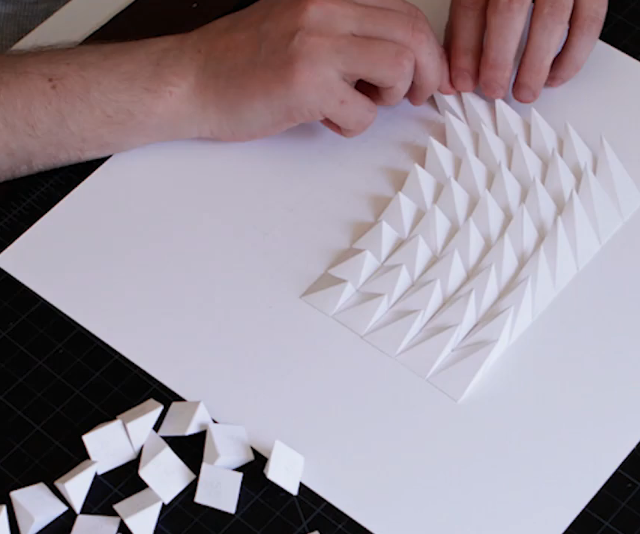
Watch this short video as Matthew Shlian talks about himself, how he learns and the role that curiosity plays in his work. Then think about the kind of classroom that would foster Matt and learners like him. Matt states:
I failed at math. I failed at Algebra. But I can understand things if I can see them. And I can actually understand them better if I can hold them in my hand. … A lot of my work is about curiosity. I come to understanding by making. If I can see what something’s going to look like when it’s finished, then I don’t want to make it. That would be like filling out a form.
If I can see what something’s going to look like when it’s finished, then I don’t want to make it. That would be like filling out a form.
As the video description notes:
Matthew Shlian works within the increasingly nebulous space between art and engineering. As a paper engineer, Shlian’s work is rooted in print media, book arts, and commercial design, though he frequently finds himself collaborating with a cadre of scientists and researchers who are just now recognizing the practical connections between paper folding and folding at microscopic and nanoscopic scales.
An MFA graduate of Cranbrook Academy, Shlian divides his time between teaching at the University of Michigan, mocking up new-fangled packaging options for billion dollar blue-chips, and creating some of the most inspiring paper art around.
Ghostly teamed up with the Ann Arbor-based photographer and videographer Jakob Skogheim, to produce this feature short, which combines interview and time-lapse footage of Shlian creating several stunning new pieces.
It’s unfortunate that student don’t get to use their innate perceptual skills more often in the classroom. Instead of discovering patterns on their own, students are “taught” to memorize patterns developed by someone else. Rather than do the messy work of having to figure out what’s going on, students are saddled with graphic organizers which take all the thinking out of the exercise.
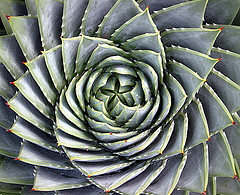
“Doodling in Math Class: Spirals, Fibonacci, and Being a Plant” captures the fascination of patterns in nature. Discover more patterns from Vi Hart – Mathemusician
I recently featured a guest post from High Tech High’s David Stahnke and Margaret Noble that detailed their award-winning student multimedia exhibit “Illuminated Mathematics.”
Margaret is back with another student project, partner and guest post. Text by Rachel Nichols and Margaret Noble.
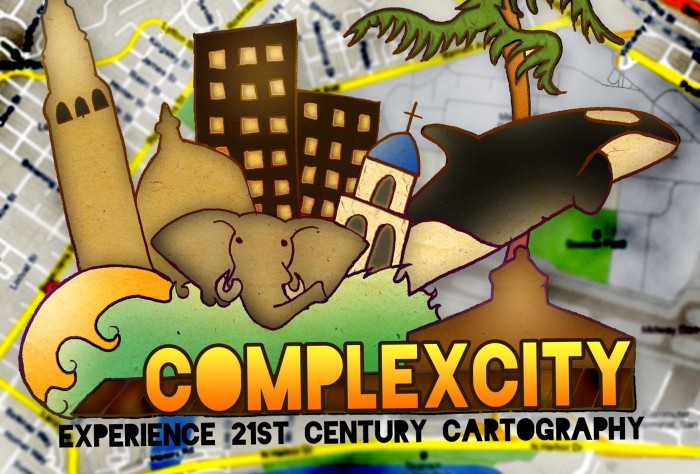
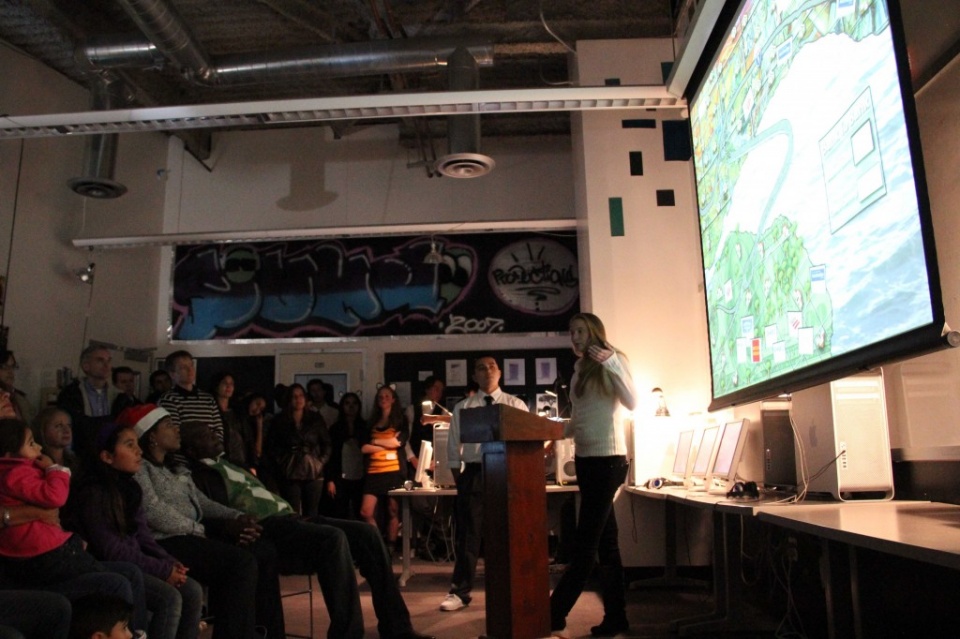
Complex City: Animated Maps of San Diego Project and student exhibition developed and coordinated by High Tech High teachers – Rachel Nichols (English) and Margaret Noble (Multimedia).
Link to the Complex City exhibit sitewith additional student work.
Our Essential (Guiding) Questions
San Diego’s military bases drastically outnumber the facilities meant to help veterans with post war trauma. ~ Tobi Brik
How do we help students to become more aware of their surroundings, in order to foster an educated, ethical, and empathetic community?
How do we facilitate opportunities that help students translate experiences, investigations, and ideas into artistic renderings that effectively communicate new knowledge?
Summary We devised an experiential project, “Complex City” in order to help students think critically about their communities. In asking them to map an area of San Diego that had significance to them, we wanted them to step back from the familiar aspects of their community and city, and translate those aspects into a visual map. As part of this project, students researched, interviewed, and investigated their city and community in myriad ways. What they once thought was familiar suddenly became very unknown. By compiling their work and making collective and idiosyncratic maps of San Diego, they have been challenged to rethink what they understood to be the reality of the built environment around them, as well as to accept the new knowledges that their classmates contribute. They have become more invested in their own community because their new knowledge implicates them as involved citizens. These maps collect particular versions of this place (versions not always visible to others, or in traditional maps) as we see it in the fall/winter of 2011.
Student Assignment
From pursuing this question my love for marine life grew and my desire to help raise awareness for San Diego’s waters grew … I have a responsibility to get reckless boaters to be more cautious. ~ Jasmine Thomas
In this project, you will be making an animated map of San Diego based on your wanderings, interviews, research, and experiences. In short, you will be creating a map of San Diego that collects particular versions of this place (versions not always visible to others, or in traditional maps). Using Rebecca Solnit’s Infinite City as one model, and our own creative explorations as another, we will be collecting data in the form of sounds, photos, historical information, interviews, and ephemera, and we will be compiling this data to make a series of complementary, contradictory, confounding or even contestatory maps of San Diego. We will be looking at Infinite City in detail, as well as working with archivists, historians, and community members to think creatively about mapping.
Bench Marks Research Paper Outline, Story Board of Map – Oral Presentations
Rough Research Draft Paper, Map Draft 2, Final Research Paper
Map Animation Draft 1 with Critiques, Map Animation Revised with Critiques, Final Animation
Public Exhibition – Projection Art and Research Presentations
Complex City Public Exhibition
Three Essential Components:
1. Research Audio: 2-3 interviews relating to the theme/topic of your map. Each of these interviews will take the final form of a 2-3 minute piece, edited down from a 45-minute interview. Also record ambient noise and sonic data from your theme/topic. See example at The Soundlines Project.
2. Textual: a. One 6-8 page final paper per group (double-spaced; between 1500-2000 words). This draft should be divided into sections that include historical information, relevant current facts and anecdotes, and a critical analysis of the map and its meaning. The draft should be clearly marked as to which member of the group authored which sections. We will critique and workshop these papers.
b. Type a transcript from each of your interviews to turn in with final paper (due November 18th)
3. Visual: design, cartography and photography relevant to your project inquiry.
Project resources courtesy of Rachel Nichols and Margaret Noble
Gem City Atlas Rebecca Solnit’s work with students at the University of Wyoming
Gap Minder– A non-profit venture- a modern “museum” on the Internet – promoting sustainable global development and achievement of the United Nations Millennium Development Goals.
Excellent interactive map that details the 2010 census. Plug in your zip code and see what you find.
GeoCommons is the public community of GeoIQ users who are building an open repository of data and maps for the world. The GeoIQ platform includes a large number of features that empower you to easily access, visualize and analyze your data.
Strange Maps showcases very cool maps and map ideas.
Mike Wirth Art Samples from a very creative designer who makes fantastic infographics.
Grassroots Mapping – founded by a group of activists, educators, technologists, and community organizers interested in new ways to promote action, intervention, and awareness through a participatory research model.
I recently blogged from the 2011 US Innovative Education Forum (IEF) sponsored by Microsoft Partners in Learning. This is part of a series of IEF guest posts. For more, click my IEF tag. ~ Peter
More than 700 teachers, school leaders, education leaders, and government officials from more than 70 countries attended this year’s 2011 Partners in Learning Global Forum – an action-packed week of education workshops, inspiring networking events, awards, and announcements by Microsoft. Eighteen recipients of the Global Forum Educator Awards were announced at the event. This year’s winners were selected from more than 115 projects, narrowed from more than 200,000 applicants.
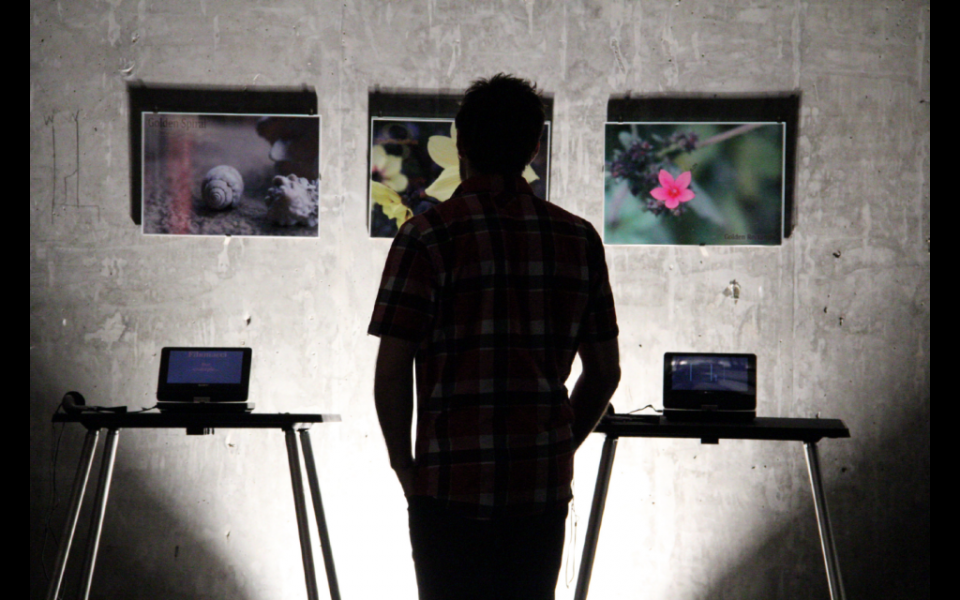
The winners in ”Knowledge Building and Critical Thinking” were High Tech High’s Margaret Noble and David Stahnke. “Illuminated Mathematics” is a curated multimedia exhibition produced by the 12th grade class of 2011.Students in Margaret Noble’s digital art class and David Stahnke’s math class were asked to find the beauty, humanity and intrigue behind math in history, philosophy and the applied arts. The goal was to promote math awareness through art, media and design. The event was hosted at the Sushi Performance and Visual Art Center on December 16th, 2010. Projects developed into an array of math abstractions and celebrations in the mediums of sound, video, animation, photography and interactive installation.
~ A guest post written by Dave Stahnke ~ High Tech High Media Arts ~
“Everyone, open your books to chapter 7 section 2 as we will be learning how to factor degree 3 polynomials.”
I can imagine this statement being said, in some fashion, within the vast majority of high school math classrooms across our seemingly broken educational system. Almost all of us have at some point taught something that was completely irrelevant to the lives of our students. And we knew it!
Nobody has ever come up to me on the street and asked for help with factoring, or called me late at night, unable to sleep, because they were curious as to why the square root of two is an irrational number.
The fact is that nobody has ever come up to me on the street and asked for help with factoring, or called me late at night, unable to sleep, because they were curious as to why the square root of two is an irrational number. It is unfortunate that this doesn’t happen, but I would be kidding myself if I thought these were genuine student concerns within the realm of what we call “life.” I think it is time for us as teachers to be honest about what we teach, and to question why every student needs to know the entire breadth of standards associated with a particular subject.
Deep vs. Wide
There was a study published recently in Science Education (2009) that made a comparison between teachers who “sprinted” to cover all of the standards with teachers who slowed down and went deeper into the material. The students who “sprinted” ended up scoring higher on the standardized test due to covering more material. But the students who learned through the slower, in-depth approach earned higher grades in their college classes.
Like any great symphony, mathematics represents a pinnacle of human creativity. We teach math to enrich the lives of our students in a way akin to reading poetry or composing music
Is our goal to have students performing better on standardized tests or to be prepared for what they are going to encounter in college and life? The ideal would be that they would be prepared for both. So the questions become, what do we want to leave the students with? How are we going to prepare them for the real world? What do we want them to learn about themselves? And how do we do it? To clear the air, I don’t believe that students are taking my calculus class because they need help doubling a recipe or balancing their checkbook. I believe it is because we want to expose students to the poetry of numbers, to have a new outlook on how to solve problems, to be able to think outside of the box, and to see how the unbreakable human spirit has conquered problems that once mystified the greatest of thinkers. Like any great symphony, mathematics represents a pinnacle of human creativity. We teach math to enrich the lives of our students in a way akin to reading poetry or composing music.
Bringing Math to Life
This year I wanted to do something big that would change the perception of mathematics for my students and the surrounding community… It was time for math to become art and art to become math.
This year I wanted to do something big that would change the perception of mathematics for my students and the surrounding community. My goal was to create a math exhibition that would allow students to showcase their depth of understanding in a creative way. I wanted nothing to do with the poster-board type of science fair displays. I wanted math to come alive through the work of my students. It was time for math to become art and art to become math.
In order to pull this off it was clear that I was going to need help. After all, having the students for only an hour a day seemed to be great limitation to this type of creativity. I enlisted the help of Margret Noble, a sound artist, multi-media teacher, colleague, and friend. I also got help from as many math/physics friends as I could. I contacted about thirty people. Fifteen were willing to act as mentors, spending time meeting with one or more groups of students and/or corresponding through e-mail. All of the mentors were physics Ph.D. students, or had their PhD and were working in labs or as engineers. The students found the mentors to be a great resource. As one student said, “I got a lot of positive feedback from adults. They helped me understand a very complicated topic in a very simple way.”
Student Voice and Choice
Margaret and I envisioned mixing multimedia with mathematics by having students create video, sound, photography, and mixed media installations that explored math-related topics. We started the project by creating a list of 50 topics for the students to pick from, though they were not restricted to the list. Once the students had selected a topic we had them brainstorm possible creative ways of expressing it (i.e. their product). Each student also completed a research paper on their topic and gave a power point pre-production oral presentation to explain their topic to the rest of the class.
Along the way, students participated in four in-class critiques of their products, with opportunities to revise after each one. For each critique, students displayed their work on the large screen and the rest of the class would give kind, specific, and helpful feedback. These peer critiques were key to ensuring that students produced beautiful products. As they pushed each other’s creativity and offered new ideas, students’ projects evolved into a variety of forms:
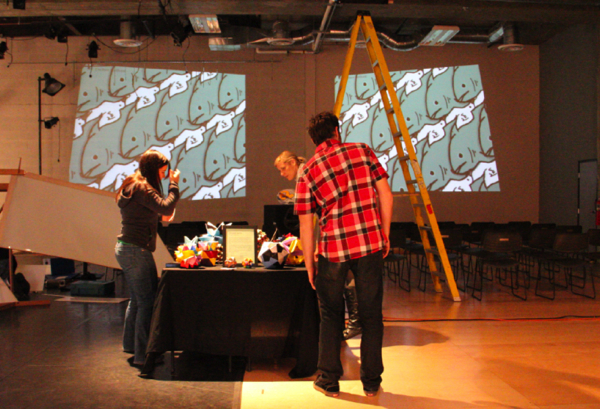
A video with animated fractals, another on chaos theory, an artistic representation of tessellations, a flash video on relativity, music produced using Pythagorean scales, photography that displayed entropy, Pi and mental illness in mathematics, a beautiful silent film which used cryptography to crack a love letter, photography and video of the golden ratio, a video/sound installation on algorithmic compositions using Markov chains, a Leonardo da Vinci model airplane explaining the physics of flight, a comical rap on the life of Pythagoras, and many more.
A student who has struggled with math in the past noted that these peer critiques were instrumental in helping students reach their goals:
During the first two critiques I was a little scared because I didn’t think that our project was good enough and had thoughts in my head saying it could be better. But after the second critique I caught fire. I had many more ideas for our project and I was motivated to make it better. On our last critique a lot of good things were said about our project and it felt good knowing that we were that much closer to having a completed senior project.
Student choice also played a critical role. Contrary to what one might assume, having students choose their own topics to explore created some of the most rigorous and authentic student work I have ever seen. Not only did the students have choice in what they were learning, they also chose how they wanted to display it. Furthermore, as the project work progressed, I realized that once the students’ buy in was there, the usual achievement gap between students almost entirely disappeared. This same student found that this project gave him something to be proud of:
I honestly am proud of my project, because our animation came a long way from what we had in the beginning. A lot of hours were put in, learning Adobe After Effects, perfecting the animation, making the concept of infinite monkey theorem as simple as possible, and staying during lunch and after school so we could finish up and meet the deadlines.
Exhibition
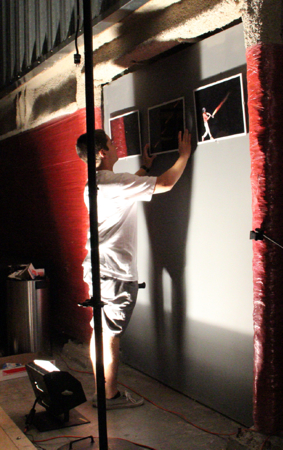
Students exhibited their final work on a Thursday evening at Sushi Contemporary Performance and Visual Arts, a gallery and performance space in downtown San Diego. The venue had professional lighting and ample wall space for multiple projections. It took us two days to set up the exhibition, hanging photos, placing installations, and installing projectors throughout the space. When the lights were turned down and the student work was illuminated it seemed almost magical. Prior to the exhibition, we had reached out to CNBC (video), Voice of San Diego, and City Beat Magazine to help promote the show. The most common phrase I heard that evening from the parents, media, and other visitors was “I can’t believe that high school students did this!”
As an educator, this experience proved to me that mathematics can not only be enjoyable for students, it can be downright memorable. This was possible through giving student choice and by letting them explore math through their own creative personalities. In the words of my teaching partner, Margaret Noble, “This project worked because math moved from the abstract realm into the tangible. Numbers and concepts became people, culture, history and philosophy that students could illuminate to the public.”
Or, as one student said, “It definitely widened my view of math. At first I thought math was only useful to scientists and mathematicians, but this project showed me that math is everywhere.” What more could a math teacher want?
Reference
Schwartz, M., Sadler, P., Sonnert, G. & Tai, R. (September, 2009). Depth versus breadth: How content coverage in high school science courses relates to later success in college science coursework. Science Education, 93, 5, 798-826.
Recently I shared lunch with colleague and friend, Mike Gwaltney. He teaches in a variety of blending settings both in class and online. We got into an interesting discussion about ways to deliver instructional content and learning process both in and outside the classroom. The conversation quickly turned to the notion of “flipping the classroom.” This is the idea that teachers shoot videos of their lessons, then make them available online for students to view at home. Class time is then devoted to problem solving – with the teacher acting as a guide to teams of students. It’s a great approach that flips the delivery of the lesson to homework – it’s like a TiVo time shift that can reshape your classroom. More about flipping here.
Watch this video to see flipping in action – cool graphics courtesy of Camtasia Studio.
Both of us admired teachers (like these in the video) with the time, technology and talent to do video productions – but questioned how many teachers would be able to morph into video producers. Moreover, with the growing catalogue of free online content – we questioned why a teacher would even want to bother to produce their own online material. As Mike quipped – “why would someone video their own Lincoln lecture – when you can watch Gary Wills online?”
Flip the delivery of the lesson to homework – it’s like a TiVo time shift that can reshape your classroom.
Ultimately, we saw flipping the class as a great opportunity to engage our students in taking more responsibility for their learning. Why not let your students curate the video lessons from existing content on the web? As a follow up to our chat, here’s my seven-step how to:
1. Start slow! Pick a single upcoming lesson or unit that you already plan to teach.
2. Recruit a few of your savviest students to do the research to find existing online video material to support the lesson. They should include a text overview defining what the students should be looking for in the video.
3. Also work with the student team to develop an in-class activity that students will do after viewing the video.
4. Post the video lesson to your content manager. Don’t have one? Just use a free Google website – very easy to embed or link to videos there.
5. Then run the video as a pilot lesson for the whole class. Part of their assignment is to decide what they like (and don’t like) about the each component of the lesson. In other words, they assist in the design of rubrics for selection of videos and integration of the video lessons into a classroom activities.
6. Then repeat step 1-3 until you get a good basis for selection of future videos.
7. Repeat 1-6, as needed, until your students have curated a collection of online content to support your classroom. They would also be responsible for better defining what constitutes “high-quality” online content and how that can be best used to support a more student-centered classroom.
Extension: You might even consider adding some pre-assessment for upcoming units – using a formative pre-test or student self-assessment rubric to let students decide which elements of an upcoming unit need video support. Then based on the formative assessment – assign teams of students to curate online content while you work with them in class to design future follow up class activities. If this process works, think of all the class time you would free up. No concerns of running out of time to “cover” the required material. Instead of class time being filled with the pointless transfer of information from teacher to student, you and your students would have the time to apply and explore the content in a more engaging and project-based classroom. Who knows you might gain so much time that you’ll have the chance to discover your inner Scorsese – and go on to produce your own instructional videos?
 Watch this short video as Matthew Shlian talks about himself, how he learns and the role that curiosity plays in his work. Then think about the kind of classroom that would foster Matt and learners like him. Matt states: