Peter Pappas »
28 June 2009 »
In Ed Tech, How To, Literacy, Presentations, Strategies, Teachers, Visualizations, Web 2.0 »
This week I head back to Edison School of Engineering & Manufacturing, to conduct a two day follow up workshop. Our previous work together identified four target areas:
- Motivating students
- Making learning relevant
- Student-centered learning strategies
- Effective use of technology
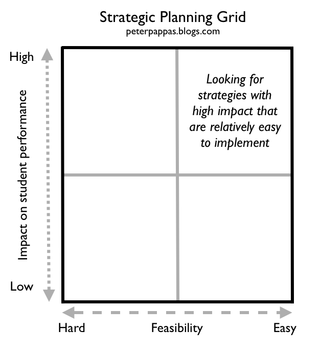
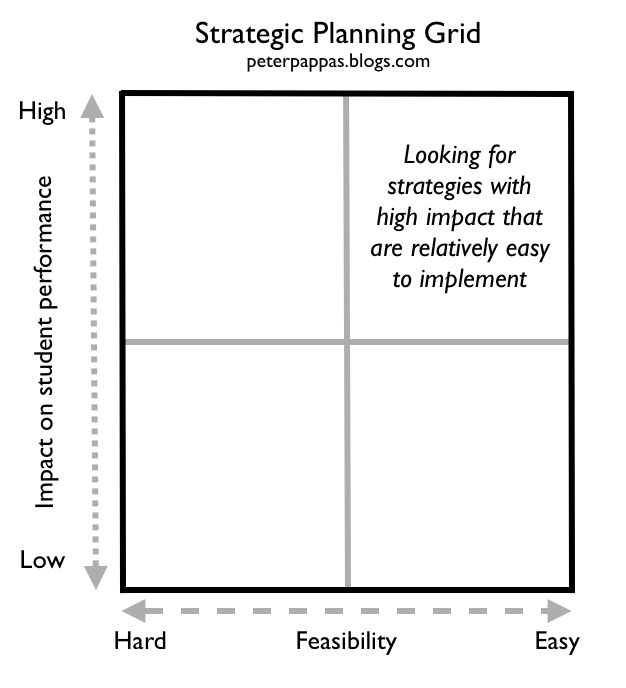
We are going to start by modeling a "Brainstorm, Group, Label" activity (See Tool 13). It will also set our agenda for the "make and take activities" of the workshop. Day two begins by modeling a "Fishbowl Discussion Group" on the topic of effective next steps. We'll use the ideas generated in the fishbowl to design a Strategic Planning Grid (below) to prioritize their staff development for the fall.
Most of our time over the two days will be spent assisting teachers in designing specific lessons. I've assembled some Literacy Strategies that teachers can use as starting points for modify their existing lessons.
“Non-readers” for students who lack decoding skills.
“Word-callers” for students who can decode, but lack comprehension skills.
“Turned-off readers" for students who have the decoding and comprehension skills, but lack motivation or engagement.
I'll also be showcasing some web tools that are very engaging for students.
Wordle (text analysis)
Many Eyes (data and text visualizations)
Prezi (presentation tool)
Dipity (timeline builder)
Bubbl.us (brainstorming)
Flickr Tag Related Tag Browser (image tag analysis)
Tags: Bubbl.us, Data, Dipity, Engagement, Fishbowl, Flickr, Many Eyes, Motivation, Relevance, Rochester, Visual Literacy, Wordle
Peter Pappas »
18 December 2008 »
In Ed Tech, Literacy »
Kevin Kelly’s recent piece “Becoming Screen Literate” (NY Times 11/23/08) details our transition from text literacy to screen literacy. This movement has great implication for education. Information in our schools is organized in text-based lineal fashion. Our students live in a mosaic, imaged-based world in which visuality has become the new literacy.
Screens are everywhere. YouTube videos and Flickr images have become rich databases of component images and videos for yet new mash-ups and user-generated content. Kelly predicts this visual content will soon surpass our linguistic content as new tools will enable users to search, copy, modify and reassemble visual content with near word-processor efficiency.
Tags: Data, Dipity, Information landscape, Innovation, Kevin Kelly, Visual Literacy
Peter Pappas »
18 October 2008 »
In Ed Tech, History / DBQ's, Publishing, Strategies, Web 2.0 »
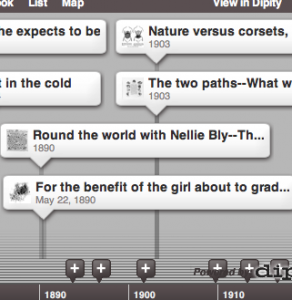
I’ve been experimenting with Dipity, a new website that allows you to build interactive timelines. Open a free account, create a new topic, and then upload text and images (from a file.) You can view your topic as an timeline or flipbook. You can even geocode your events and view the project as a map. You are allowed to set permissions for viewers and editing rights. I created a sample timeline “How did the roles and rights of women change at the turn of the 20th century?”
Tags: Dipity, Innovation, Sequencing, US History, Women's rights
Recent Comments