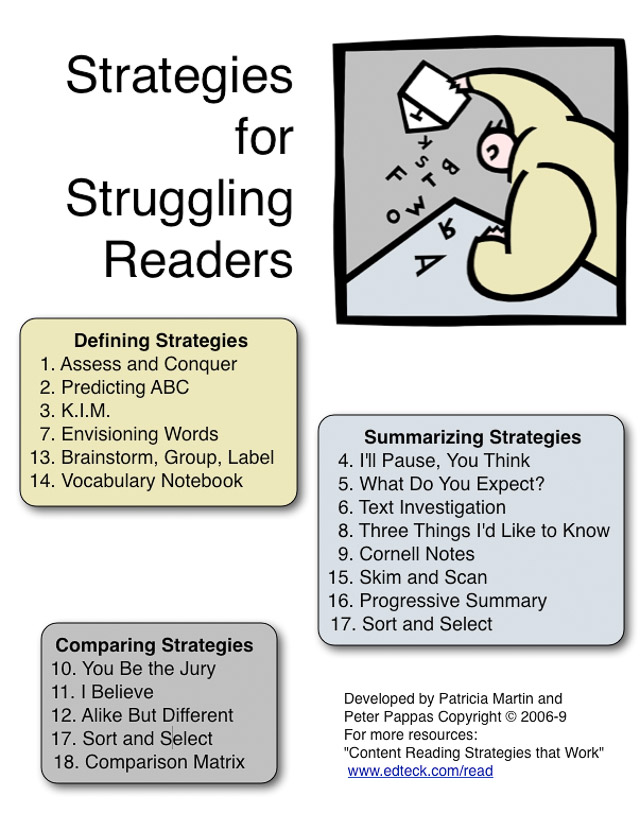
I’ve been working with teachers to develop learning strategies to support the Common Core literacy and comprehension skills that students commonly use across the content areas. This pdf includes 18 lessons organized in two ways: by comprehension strategy – defining, summarizing and comparing and by target reader – non-reader, word caller and turned-off reader. The lessons are designed as templates which teachers can modify to use in their specific subject areas.
Strategies for Struggling Readers 3MB pdf
There are two key elements that teachers should keep in mind when working in each skill area.
Defining
- Before the formal definition has been introduced, students should be asked to make connections between their prior knowledge and the term.
- After the term has been defined, students need activities to more deeply process the term.
Summarizing
- Students should be asked to make their own judgments about what’s important to them (instead of just repeating the details the teacher highlights).
- Students will be able to more readily summarize, if they are asked to share what they’ve learned with an audience other than the teacher.
Comparing
- Students should develop the comparison, not simply repeat the model that we present to them.
- Student should be asked to share what they learned from the comparison.

Hi there, Great resource. What really stands out to me are the names of the strategies. As a teacher of teenagers with learning disabilties it is hard to find resources that don’t sound too childish. These strategies don’t look like that at all.
Thanks again
Hi there what is a good way of helping older students who has very little phonemic awareness skills.
I am looking for lesson plan to teach middle or high school kids phonemic awareness. They are very bad spellers and readers, they are in high school but i really feel the need to go back to basics and revisit phonics. What do you think? And do you have you seen any good lesson plans out there that won’t be to boring for 7-10th graders? Please drop me a line I need something very soon school starts Monday.
SSM,
Glad you liked the tool kit! Pat Martin and I worked hard to create something useful to students and teachers – I guess the naming was an unintended plus.
Thanks,
Peter
Hi spedteachertrainee / educatortrainee,
My colleague, Pat Martin, will contact you directly.
Cheers,
Peter
Thank you! Pat was a big help. She is really a great resource she will certainly be hearing more from me in the future as I navigate through my training/career. You all keep up the good work now!
By the way did I mention I work for a PBL school. I’ve definitely bought into the idea of “relinquishing responsibility for learning to students”. We definitely appreciate your work around here.
As a teacher in sped for a long time, your information reinforces and renews. Thank you so much.
My quest at this time is the exploration of vocabulary, specifically through affixes. (This is in addition to the in-context text vocabulary exploration that we already do) Just wondering if anyone might have ideas on teaching prefixes, suffixes and roots. It can be so empowering when kids can determine the meaning of new words based on this kind of knowledge. I’d love any input!
Thanks ~
A member of my PLN on Twitter recommended this. I’ve downloaded it for study. My focus is on teaching writing grades 7 and above, but many skills students need to write are only taught (if taught!) as reading skills.
Thanks for sharing.
Linda
Thank you for this invaluable resource – Will be sharing this with colleagues!
Very good information, especially for children with learning difficulties. You might also remind parents that if all else fails, reading problems could be the result of vision problems (as was the case with my daughter) or even perceptual disorders where letter or words on the page appear as bunched together or moving around. One of my wife’s students had something called Irlen Syndrome which made it difficult to read until she used colored lenses. I read that nearly 25% of young readers (including teens) have reading problems that are vision or perceptually based. My point being simply that there are kids with problems beyond the many excellent strategies and these should also be discussed at some time. Thank you.
Rich,
Thanks for that helpful reminder. It makes me recall a friend’s child who had an undiagnosed hearing problem that inhibited his speech development. Fortunately, when it was detected – he rapidly got up to speed.
I am an ESL teacher and teaching students to read is a difficult task for me. i am looking for ways how to help them feel at ease with reading and this really is a big help. thank you so much! i will definitely use the kit you’ve provided. just wish you also have the same for writing. 🙂
Thank you SO much!
Hi Gina,
Glad to be of help. Hope you have a great school year
~ Peter
Dear Mr. Pappas,
You are currently my favorite person in the world. Thank you so much for these strategies–next year will be my first year at this struggling school. These strategies are absolutely perfect for my high school freshmen (who read at a 3rd grade level, on average). I cannot wait to implement these strategies. I am so appreciative that you provide this .pdf for free. Thank you!!!
Lauren,
Thanks for taking the time to comment. When I hear that one of my posts has found an audience, it makes the effort worthwhile. Best of luck in the school year.
Thanks for consolidating all those wonderful ideas into one document. I work with ELs so the article on phrases and graphic organizers in the NY Times was exactly what I have been working on these past few months. Your ideas are a great help and I will pass the website on to colleagues. Thanks, Linda
Hi Linda,
I’m glad you found the lessons to be useful. Thanks for taking the time to comment.
Cheers in the new year ~ Peter
I appreciate you sharing these strategies. I have some very low level readers in freshman World History so I think my ICS teacher and myself may actually be teaching some of them how to read to find meaning. Thanks!
Kristen,
Glad these help. Reading for meaning is critical – at the very least, students need to realize a passage represents someone’s thinking. Cheers ~ Peter
This PDF is amazing. I can’t wait to share it with the teachers with whom I work! We have so many students who are word callers, and I am hopeful that maybe we can help some of them by using your strategies. Thank you so much!
Shirley,
I’m pleased you found these strategies to be useful.
Peter
WOW!!! I love this PDF. I saw so many ways to use all this stuff in my own classroom, as well as sharing with my team at school so they can use this information to help students read in their own subject area!!! THANK YOU, Peter! You are AWESOME!!
Denisa,
Thanks – you made my day
~ Peter
Wondering why you don’t mention dyslexia and the evidence based interventions that would be needed? You reference “non-readers” but don’t go further to give a full explanation of these readers that struggle with the phonological component of language.
Hi Deborah,
I’m not a reading specialist – that was the role of my collaborator in this effort – Pat Martin. I was more focused on framing the activities. Looks like you have some suggestions. I encourage you to comment again and offer your perspective.
Cheers – Peter